
Emerging Trends in K–12 Education: How C-STEM Prepares Students for Promising Futures
K-12 education is shifting from questioning whether technology will transform learning to focusing on how these changes can benefit students. As artificial intelligence, automation, and robotics reshape required skills, schools must also address student engagement, academic achievement, educator capacity, and unequal access to opportunities.
A recent eSchool News article examining emerging K-12 education trends for 2026 identified an important shift: innovation in education is no longer simply about putting new technology in the classroom. Schools and districts are increasingly focused on whether new approaches improve learning, prepare students for the future, and meaningfully support teachers.
For C-STEM Teacher and Student Support Services, these trends reinforce an approach the organization has championed for over two decades. Since 2002, C-STEM has integrated communication, science, technology, engineering, mathematics, creativity, and hands-on problem-solving to help students understand both the content and its relevance to their futures.
Since its founding, C-STEM has served over 300,000 students, delivered 50,000 hours of training, and impacted more than 800 classrooms. As technology and workforce needs change, C-STEM adapts its programs to connect emerging technologies with meaningful student learning and future STEM opportunities.
From Technology Adoption to Meaningful Learning
Rapidly evolving technologies like artificial intelligence are reshaping the skills students need for college, careers, and daily life. However, technology is not the ultimate goal.
Students need opportunities to think critically, solve problems, collaborate, communicate, experiment, learn from failure, and apply what they learn. Project-based learning plays a key role in developing these skills.
C-STEM’s Challenge curriculum enables students to work individually and in teams to investigate real-world problems, design solutions, build projects, test ideas, and communicate their learning. The curriculum draws on industry expertise and aligns with national and state standards.
Instead of only learning STEM concepts, students apply them in practice.
The “C” in C-STEM stands for Communication, which is essential. Students must not only build, code, calculate, or design, but also explain their reasoning, present solutions, collaborate, listen to diverse perspectives, and communicate with various audiences.
These abilities link technical competence to leadership, collaboration, and workplace readiness. C-STEM often receives feedback from students about the lasting value of the interpersonal and communication skills they gain.
AI Literacy Requires a Thoughtful Approach
AI is a defining education trend for 2026. As schools decide how to use these tools, students must understand their capabilities, limitations, responsibilities, and potential.
C-STEM addresses this need by offering AI and emerging technology experiences that introduce fundamental concepts and emphasize critical thinking, fact-checking, responsible use, privacy, and human judgment.
Students learn that AI is a powerful tool for learning, creativity, and problem-solving, but people remain responsible for how they use it.
This approach reflects a broader shift in education. AI literacy goes beyond knowing how to use tools; it involves understanding when technology is helpful, recognizing when human judgment is needed, questioning information produced by technology, and evaluating it critically.
These skills will become increasingly valuable as students enter workplaces where AI is integrated across many occupations and industries.
Preparing Students Through Hands-On STEM
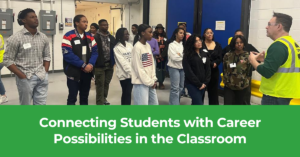
Another key trend is the increasing connection between classroom learning, real-world application, and future careers.
Today’s students may become software developers, engineers, healthcare professionals, entrepreneurs, electricians, robotics technicians, manufacturing specialists, or enter careers that do not yet exist.
Preparing students for the future requires more than exposure to specific technologies. They need technical experiences, durable skills, and career awareness.
Employers across industries seek individuals who can analyze information, troubleshoot, collaborate, adapt, communicate, and develop solutions. C-STEM’s focus on computational thinking helps students build these transferable skills.
Computational thinking teaches students to break complex problems into manageable parts, identify patterns, develop processes, test solutions, and use information to make decisions. These skills are not limited to computer science. They apply across technology, engineering, manufacturing, healthcare, skilled trades, entrepreneurship, and many other fields.
C-STEM’s Coding, Robotics Prototyping, Innovation, Early Learner, Film, Photography, Debate, and other Challenge modules give students multiple entry points to develop these capabilities while discovering where their interests and talents may lead.
Supporting Teachers Multiplies the Impact
Technology and curriculum changes are effective only when educators can use them well. This makes professional development essential in today’s K-12 landscape.
C-STEM meets this need through its accredited Integrated C-STEM Training Institute. The self-paced teacher training offers professional learning, curriculum resources, and tools to help educators integrate project-based STEM, communication, and hands-on learning into classrooms and after-school programs.
Supporting educators creates a multiplier effect. Well-prepared teachers can apply new strategies across multiple classrooms and student groups over time.
This teacher-first approach reinforces a key principle: technology should not replace educators. Teachers need knowledge, confidence, resources, and support to determine how technology and instructional strategies best advance student learning.
Expanding Access to STEM Education
One of the most significant connections between current education trends and C-STEM’s mission is access.
As STEM, AI, computational thinking, and emerging technologies become increasingly linked to future education and careers, students need early opportunities to develop these skills. However, access to advanced STEM, computer science, technology, and workforce experiences remains unequal across schools and communities.
C-STEM’s mission includes supporting educators in delivering high-quality, project-based STEM learning to students historically underrepresented in STEM fields.
C-STEM continues to believe that every child should have access to a quality STEM education.
This commitment is increasingly important as technology becomes embedded in nearly every sector. Access to STEM education now determines who is prepared to participate in and benefit from future economic opportunities.
Preparing Students to Navigate Uncertainty
A key lesson from current education trends is that we cannot prepare students for an uncertain future by predicting the next technology. We must prepare them to navigate change itself.
We cannot predict which technologies will define the workplace in the coming years. However, we can prepare young people to ask questions, evaluate information, communicate ideas, collaborate, solve new problems, use technology responsibly, learn continuously, and adapt to change.
These capabilities have long been at the heart of C-STEM’s approach.
Through educator training, project-based curriculum, computational thinking, AI and robotics experiences, competitions, and hands-on STEM challenges, C-STEM links today’s student learning with tomorrow’s opportunities.
The future of education is not just about introducing new technology. It is about preparing educators to use innovation effectively and ensuring every student can become a creative thinker, confident communicator, responsible technology user, and capable problem solver.
This is how we prepare students not just for the next technology, but for the promising futures they will help create.